

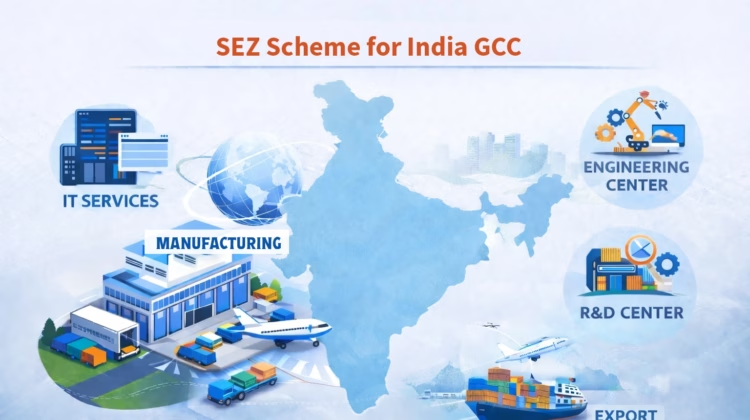
SEZ Scheme (Special Economic Zone Scheme) continues to be structurally relevant for Global Capability Centers (GCCs) even after the sunset of direct income tax holidays. The value proposition has shifted from direct tax arbitrage to indirect tax efficiency, customs optimisation, capital flexibility, and regulatory ease.
Below is a structured explanation tailored to GCC decision-makers.
What is an SEZ Scheme?
An SEZ is a notified geographical territory treated as a deemed foreign territory for trade operations and duties. SEZ units are governed by the SEZ Act, 2005 and SEZ Rules, 2006, providing a distinct regulatory and fiscal regime compared to the Domestic Tariff Area (DTA).
Key characteristics:
- Designed primarily for export-oriented units (EOUs)
- Separate customs boundary (zone)
- Liberalised foreign exchange regulations
- Simplified compliance through single-window approvals
SEZ Presence Across India – GCC Clusters
SEZs are operational across Tier 1 and Tier 2 technology and industrial hubs.
| Tier 1 Cities | Tier 2 and Tier 3 Cities |
|
|
Noe: Most major IT/ITeS clusters have notified IT-specific SEZs with ready infrastructure.
Types of SEZs Relevant for GCCs
There are variants in SEZs, from a sector-specific to a captive SEZ, which can be opted for.
(A) Sector-Specific SEZs
- IT / ITeS SEZs (ideal for GCCs, captive offshore centers, R&D hubs)
- Manufacturing-specific SEZs
(B) Multi-Sector SEZs
- Allow both manufacturing and services
- Suitable for integrated GCC + manufacturing support structures
(C) Captive SEZ / Co-Developer Model
- Large corporations can:
-
- Develop a captive SEZ
- Become a co-developer in an existing private SEZ
Why SEZ Scheme Still Makes Strategic Sense for GCCs (Post Income Tax Sunset)
Although the direct income tax exemption has expired, the operational economics remain attractive.
Customs & Import Advantages
SEZ units still enjoy 100% duty-free import of:
- Capital goods
- Raw materials
- IT hardware
- Equipment required for authorised operations
This is very beneficial as customs duty ranges from 10 to 40% in in many operations and, by virtue of an upfront exemption, results in substantial cost savings.
- Engineering centres and R&D centers or any other GCC requiring frequent import of hardware.
- Other hardware-intensive GCCs (R&D labs, semiconductor design, testing, prototyping)
- Manufacturing Centers with a need to import plant and machinery
GST Efficiency
SEZ units also enjoy:
- Zero-rated supplies for exports
- GST exemption on domestic procurement for authorised operations
- Simplified input credit mechanism
Compared to DTA operations, working capital blockage is lower.
DTA operations are for the local domestic market.
Foreign Exchange & Capital Flexibility
It’s easier to operate for investments, costs and profit repatriations.
- Most sectors are covered under automatic investment routes without any hassles of permissions from the government.
- External Commercial Borrowings (ECBs) up to USD 500 million per year via recognised banking channels without minimum maturity restrictions (as per prevailing RBI norms)
- 100% repatriation of profits (Dividends) after payment of minimum alternate tax and dividend distribution tax.
- Liberalised foreign exchange regime as compared to DTA units.
For global headquarters funding structures, this reduces friction.
Regulatory Ease
Since SEZ is a Union Government scheme, the units operating in SEZ enjoy an umbrella cover under Unions control through jurisdictional commissioners. In case of any hurdles its easier to approach the Jurisdictional Commissioner, who is a central government representative reporting to the SEZ board in New Delhi.
- Single window clearance
- Faster customs procedures
- Reduced interface with multiple authorities
- In many states: exemption from stamp duty
For GCCs operating under tight launch timelines, regulatory predictability is a major advantage.
Ideal Use Cases for SEZ-Based GCC
SEZ works best when:
| GCC Type | SEZ Suitability |
| IT / ITeS captive center | High |
| Engineering R&D center | Very High |
| Product development with export focus | High |
| Manufacturing + shared services | Very High |
| Domestic market-focused shared services | Moderate |
| Purely India-facing service center | Low |
Strategic Positioning: SEZ vs Non-SEZ GCC
| Factor | SEZ | Non-SEZ |
| Customs duty | Exempt | Applicable |
| GST on procurement | Zero-rated | Pay & claim credit |
| Income tax holiday | Not available | Not available |
| Export obligation | Mandatory | No |
| Compliance | SEZ-specific | Standard |
Core trade-off:
SEZ brings fiscal and customs efficiency but imposes export obligations and zone-based operational requirements.
Policy Context: Future of SEZ in GCC Strategy
India is evaluating reforms toward more flexible economic zones aligned with global best practices (similar to UAE free zones). If regulatory rationalisation occurs, SEZ-based GCCs may regain strategic prominence.
Given India’s increasing focus on:
- Manufacturing exports
- Semiconductor ecosystem
- Deep-tech GCCs
- Integrated design-to-manufacturing models
SEZ remains a structurally relevant vehicle.
Conclusion
Despite the SEZ scheme no longer offering a pure income-tax arbitrage instrument, they offer variety of fiscal and other incentives, especially for Engineering Centers, R&D Centers and Manufacturing Centers. They offer a lower regulatory cholesterol for export-oriented GCCs — especially engineering, R&D, manufacturing-aligned, or hardware-intensive models. In general, for GCC, an SEZ remains a strong structural choice.

